An antique George III neo-classical style white Statuary and green Tinos marble mantlepiece
The inlaid Greek-key patterned frieze is under a break-fronted cornice shelf finely carved with dental and bead and reel detail. The reeded pilasters also carved with bead and reel detail under pearl bead oval end-blocks.
An antique Carrara marble sculpture “Venus Italica” after Antonio Canova (1757-1822)
Made in Italy during the 19th century.
When the Medici Venus was forcibly removed from the Tribuna of the Uffizi by Napoleon’s forces, King Louis I of Etruria commissioned Antonio Canova to replace the figure. True to nature, Canova submitted a wholly original figure to rival the antiquity, despite originally being asked to sculpt a copy. Canova’s Venus references the Medici Venus in the turn of the neck, but leans slightly forward, adding greater finesse to the proportioning of the figure. The Neoclassical composition also incorporates drapery which is used by Venus to conceal her nudity. This is a distinctly modern gesture, which imbues the figure with a sensuality also seen in seminal contemporary paintings such as Ingres’ Valpinçon Bather and Hayez’ Venus. The Venus Italica became an instant success when it was unveiled in the Palazzo Pitti in 1812. Canova subsequently made a number of versions, including examples for the Marquess of Lansdowne, the Marquess of Londonderry and, ironically, for Napoleon’s brother Lucien.
Canova had a number of highly skilled studio assistants who produced reductions of his sculptures both during his lifetime and after his death, Rome in the first three decades of the 19th century was filled with marble carvers of the first rate producing great work like this sculpture, many of whom worked under Canova.
A large and fine quality antique English Statuary marble fireplace from the early Victorian period
The wide jambs with recessed carved floral panels and large acanthus corbels, the centre tablet depicting a woven basket filled with summer flowers. A deep moulded edge shelf sits on top.
Made from the purest Italian Statuary marble (having little veining) and in great condition.
An antique Louis XVI period marble mantlepiece in the French Directoire style
Made from ‘Saint Anne des Pyrenees’ marble with delicate white statuary marble carvings.
The centre plaque carved with crossed torches, bow and quiver in a laurel victory wreath.
Circa 1790
Directoire
The Directoire style was a period in the decorative arts, fashion, and especially furniture design in France concurrent with the Directory (November 2, 1795–November 10, 1799), the later part of the French Revolution. The style uses Neoclassical architectural forms, minimal carving, planar expanses of highly grained veneers, and applied decorative painting. It is a style transitional between Louis XVI and Empire.
The Directoire style was primarily established by the architects and designers Charles Percier (1764–1838) and Pier François Léonard Fontaine (1762–1853). In its use of Neoclassical architectural form and decorative motifs the style anticipates the slightly later and more elaborate Empire style, which was introduced after Napoleon established the First French Empire.
The Directoire style reflected the Revolutionary belief in the values of republican Rome.
A tall and elegant antique English 18th century veined Carrara marble chimneypiece
This fine and unique Georigan fire surround made from Italian Carrara marble features a tiered moulded shelf and a distinctive curved fluted frieze on a simple moulded frame.
Please note how the mason cut the marble so that the veins run in the same eye-pleasing direction, and that the top half of the fire surround is carved from one single block of marble with the veins running straight through.
Circa 1760
Provenance: Bernard Nevill’s Chelsea apartment, (Design Director of Liberty).
A fine antique Regency period Statuary marble chimneypiece with ‘Diana the Huntress’ centre plaque
The jambs comprising of fluted pilasters with full rounded Doric columns in front. The centre tablet depicting Diana riding in a chariot being pulled by two rearing stags, surrounded by billowing clouds. To either side of the centre tablet are recessed frieze panels and end-blocks, a moulded shelf with canted corners sits on top.
The Chelsea is a tall and elegant neoclassical style fire surround in Italian Carrara marble
Modelled straight off a mid 18th century original chimneypiece which we have in stock, this neoclassical style fire surround in grey veined Carrara marble features a tiered moulded shelf and a distinctive curved fluted frieze on a simple moulded frame.
Please note how we have carefully cut the marble so that the veins run in the same eye-pleasing direction and that the top half of the fire surround is carved from one single block of marble with the veins running straight through.
Overall height can be reduced if a lower fireplace is preferred.
Very suitable for both period and contemporary interiors.
A medium sized bolection style fire surround made from Italian Arabescato marble
A classic bolection style fireplace with a gently moulded frame on plain square plinths, carved from carefully selected pieces of nicely veined Arabescato marble with markings that flow in an eye-pleasing fashion.
Made by Ryan & Smith from a beautiful block of Arabescato Carrara marble sourced in Italy.
An English 18th Century George II sienna and white statuary marble fire surround designed by Isaac Ware for Chesterfield House, London circa 1749
Made from well figured Italian Sienna marble with white Statuary marble shelf and carved embellishments. The serpentine frieze centred by a carved statuary marble peacock, (the symbol of Hera, the wife of Zeus), with scrolling acanthus leaves to either side. The serpentine shaped opening with moulded frame, the jambs with carved marble acanthus scrolls, flowers and descending husks.
Provenance:
Philip Stanhope (1694-1772) 4th. Earl of Chesterfield, Chesterfield House, London. Originally installed in the Boudoir which was later described by Country Life in 1922 as ‘the green drawing room’. In the additional images section see photographs of the very fire surround taken by ‘Country Life’ magazine in 1894 and 1922. On the photo from 1922 note the clearly matched veining which is unique like a fingerprint on both the frieze and right hand side foot-block.
Chesterfield House
Chesterfield House was a grand London townhouse built between 1747 and 1752 by Philip Stanhope, 4th Earl of Chesterfield (1694–1773), statesman and man of letters. The exterior was in the Palladian style, the interior Baroque. It stood in Mayfair on the north side of Curzon Street, between South Audley Street and what is now Chesterfield Street. It was demolished in 1937 and on its site now stands a block of flats of the same name.
Faced with the prospect of demolition in 1869, the house was purchased by the City merchant Charles Magniac, for a reported sum of £175,000. Magniac considerably curtailed the grounds in the rear, and erected a row of buildings overlooking Chesterfield Street, named Chesterfield Gardens.
The house was later purchased in 1919 by Viscount Lascelles, who later married Princess Mary in 1923. The couple moved out of the house on the weekend of 19-20 December 1931.
Philip Stanhope, 4th Earl of Chesterfield, who built Chesterfield House
The house was built on land belonging to Richard Howe, 1st Earl Howe by Isaac Ware. In his “Letters to his Son”, Chesterfield wrote from “Hotel Chesterfield” on 31 March 1749: “I have yet finished nothing but my boudoir and my library; the former is the gayest and most cheerful room in England; the latter the best. My garden is now turfed, planted and sown, and will in two months more make a scene of verdure and flowers not common in London.
An Art Deco inspired fireplace surround made in stunning and semi-precious Nero Portoro marble
With vibrant markings that flow in the direction of the fireplace opening.
Nero Portoro is an Italian marble extracted only in Porto Venere in the Tuscany region. Its beauty is evident in the deep rich colours of the black and gold, it is this contrast that creates a most perfect combination of elegance found in no other stone. The quarry is exclusive and limited, this causes Portoro to be at the top of the marble prices.
A large bolection fireplace surround of generous proportions
The substantial 12″ (300mm) wide bolection moulded frame, rests on plain square plinths.
Carved from a block of beautifully figured, Italian Arabescato Carrara marble, hand selected in Italy by Ryan & Smith
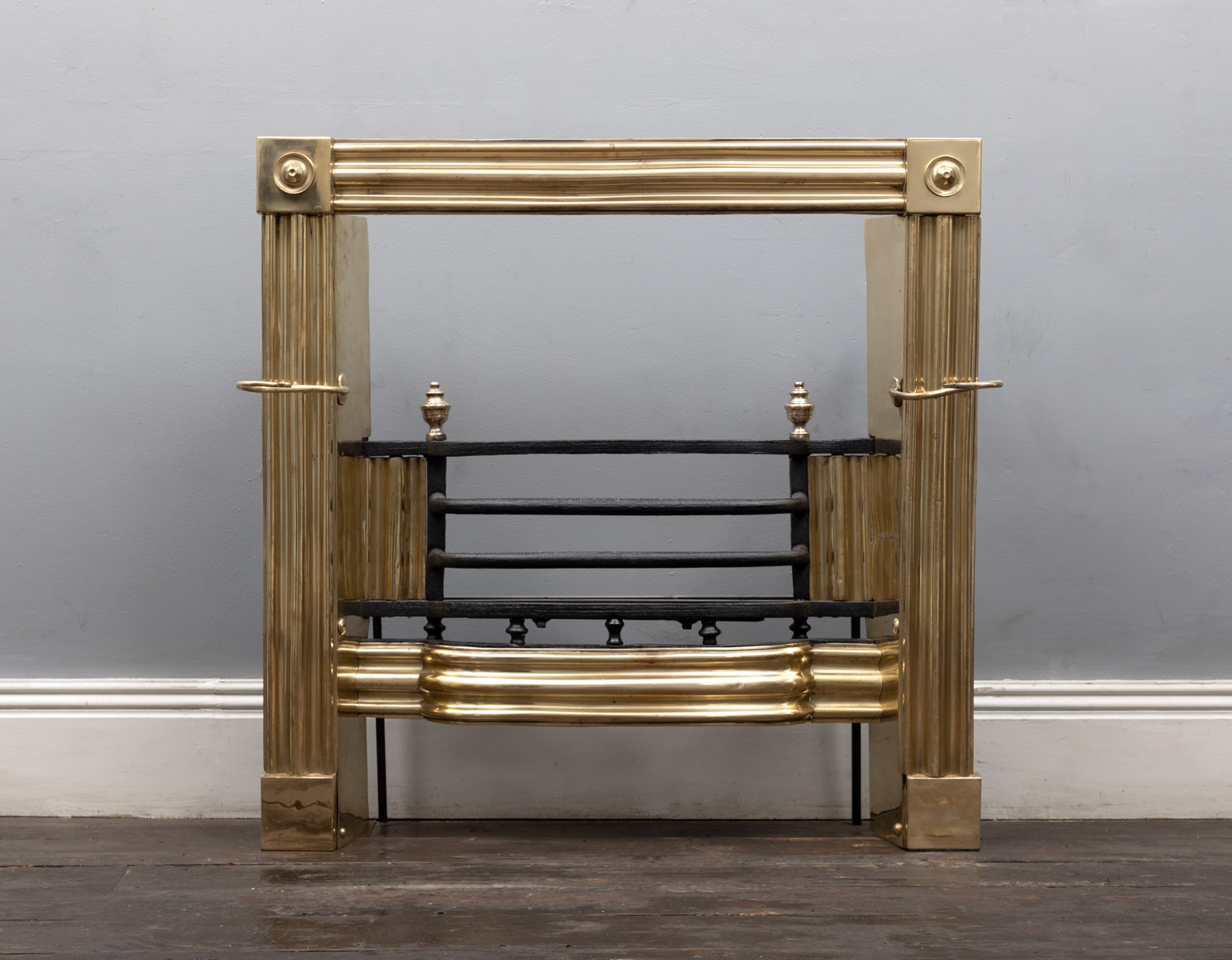
A fine antique brass and cast-iron fire basket in the Regency style
The flame finial torch uprights with intertwined snakes, flank the shaped front bars. The iron back decorated with brass leaf-work mouldings and rosettes.